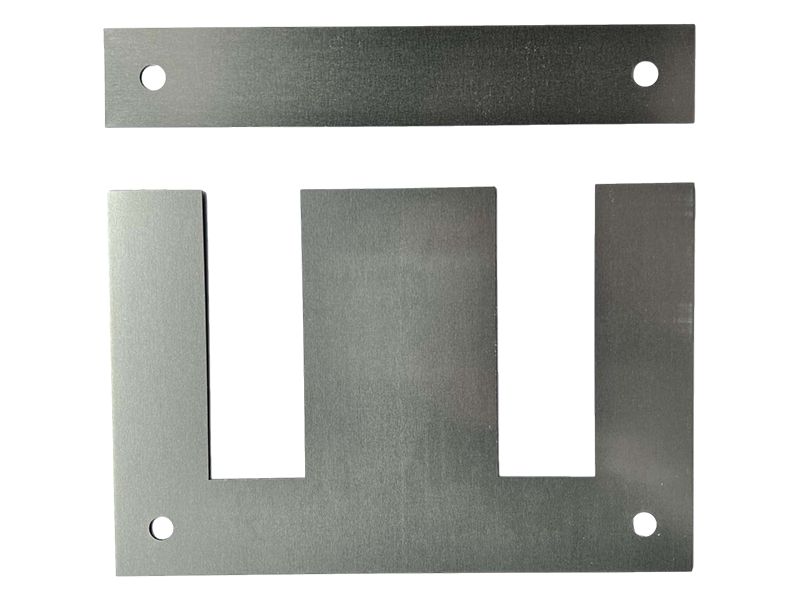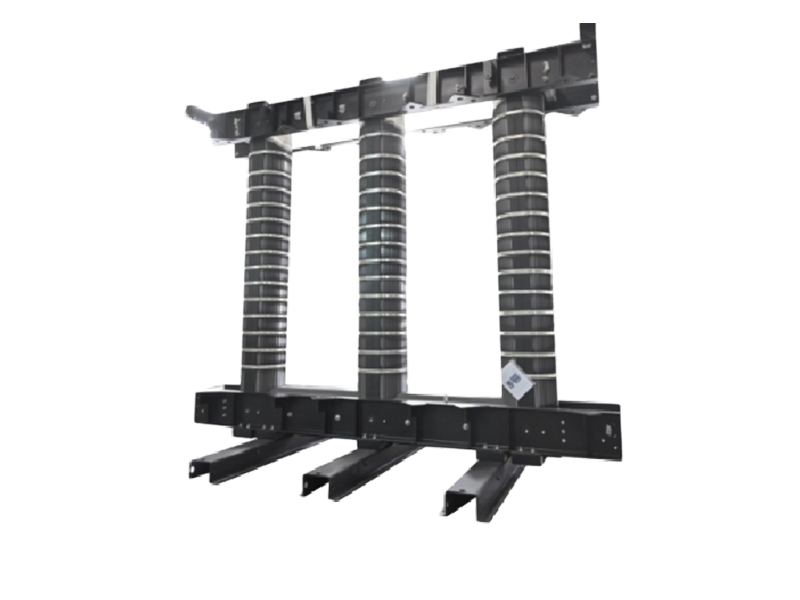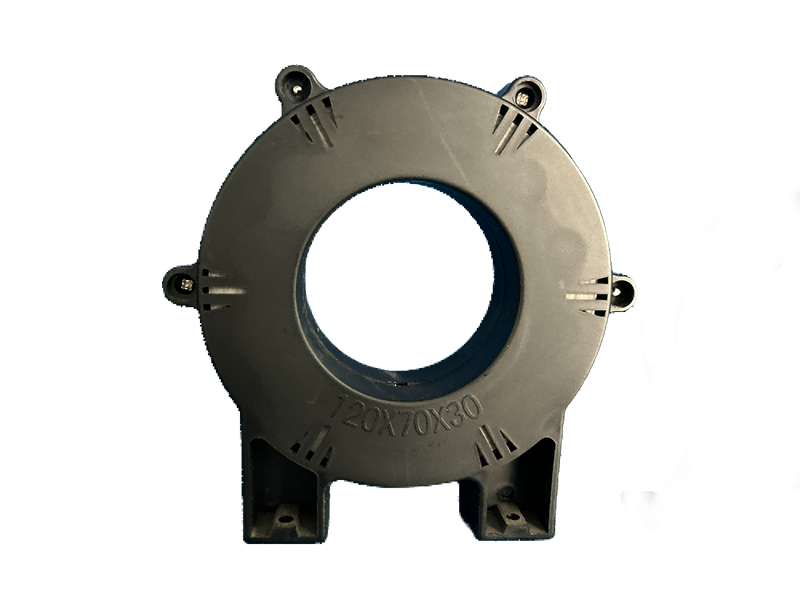
Did you know that the thickness of non-oriented silicon steel sheets can now be as low as 0.1mm? But why do we need to make oriented silicon steel sheets thinner? And what impact does this have on motor performance? Today's article by SHUNGE will take you to find out.
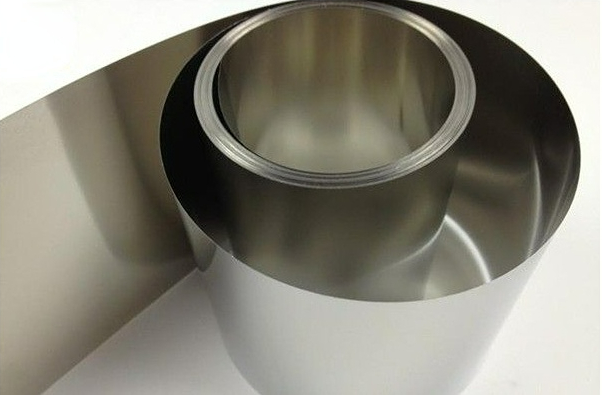
I. Characteristics of Non-oriented 0.1mm Ultra-thin Silicon Steel Sheets
The hallmark of non-oriented silicon steel sheets is their nearly uniform magnetic performance in all directions (isotropy), making them ideal for manufacturing rotating electric motors with continuously changing magnetic fields.
When the thickness is reduced to 0.1mm, it exhibits the following core features:
1.Ultralow high-frequency losses
Key Advantage: This is the primary design goal for the 0.1mm thickness. According to electromagnetic theory, eddy current losses are directly proportional to the square of the material thickness. Decreasing the thickness from the common 0.35mm or 0.50mm to 0.1mm greatly suppresses eddy current losses at high frequencies.
Application Frequency: This makes it suitable for working frequency ranges extending up to 400Hz, 1kHz, or even above 2kHz, where conventional thicker silicon steel sheets would experience excessive core losses.
2.High Electrical Resistivity
The addition of silicon (Si) in silicon steel sheets inherently increases the material's electrical resistivity, thereby reducing eddy current losses. Combining the 0.1mm ultra-thin specification with high silicon content (typically around 3%) achieves excellent high-frequency performance.
3.High Permeability
Even at moderate magnetic flux densities and high frequencies, it maintains a high permeability, meaning it requires less magnetizing current to establish the magnetic field, resulting in high efficiency.
4.Moderate Saturation Flux Density
The saturation flux density (Bs) of non-oriented silicon steel ranges typically between 1.6T and 1.8T, lower than oriented silicon steel but adequate for most high-frequency applications. It's important to note that the addition of silicon slightly lowers the saturation magnetization.
5.Good Stamping Processability
Compared to more brittle materials like amorphous and nanocrystalline alloys, 0.1mm non-oriented silicon steel sheets still retain a degree of toughness and ductility, allowing for stamping into complex shapes using precise dies.
II. Types and Characteristics of Iron Cores Manufactured
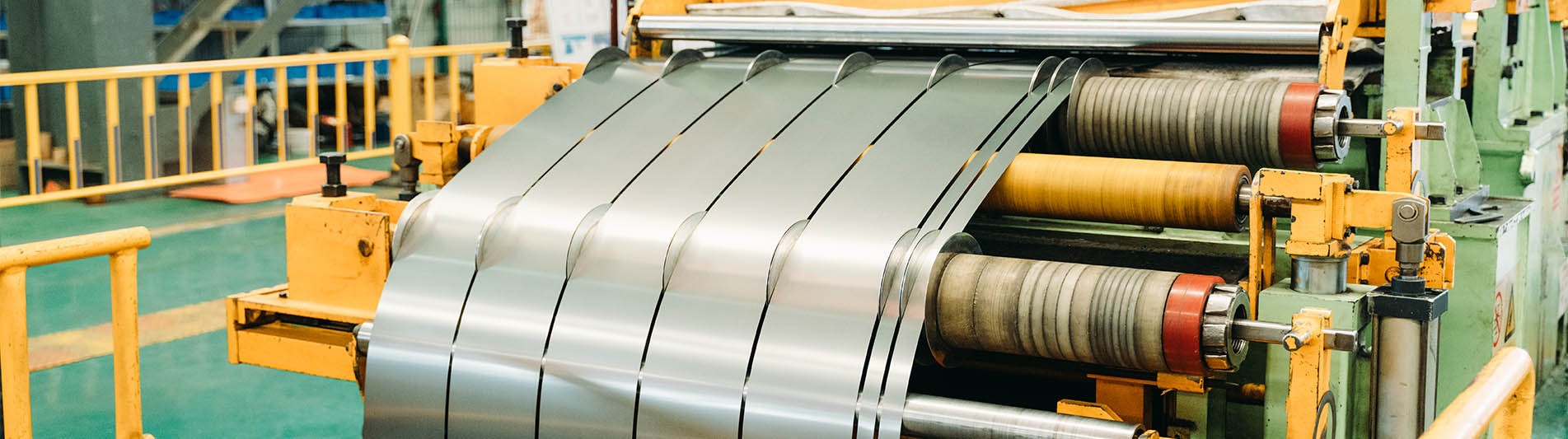
Iron cores made from 0.1mm non-oriented ultra-thin silicon steel sheets are primarily in the form of laminated cores.
1. Iron Core Manufacture Process
Precision Stamping: Utilizing high-precision presses and dies to stamp the silicon steel coils into the desired shapes.
Lamination: Stacking numerous stamped thin sheets layer by layer and securing them into a sturdy core structure using riveting, welding, bonding, or self-locking methods.
Heat Treatment: Annealing in a protective atmosphere (such as nitrogen) to relieve stresses from the stamping process, restoring the material's optimal magnetic properties.
2. Types and Characteristics of Iron Cores
These iron cores are mainly used in applications needing high-speed rotation or high-frequency magnetic fields, with the key features as follows:
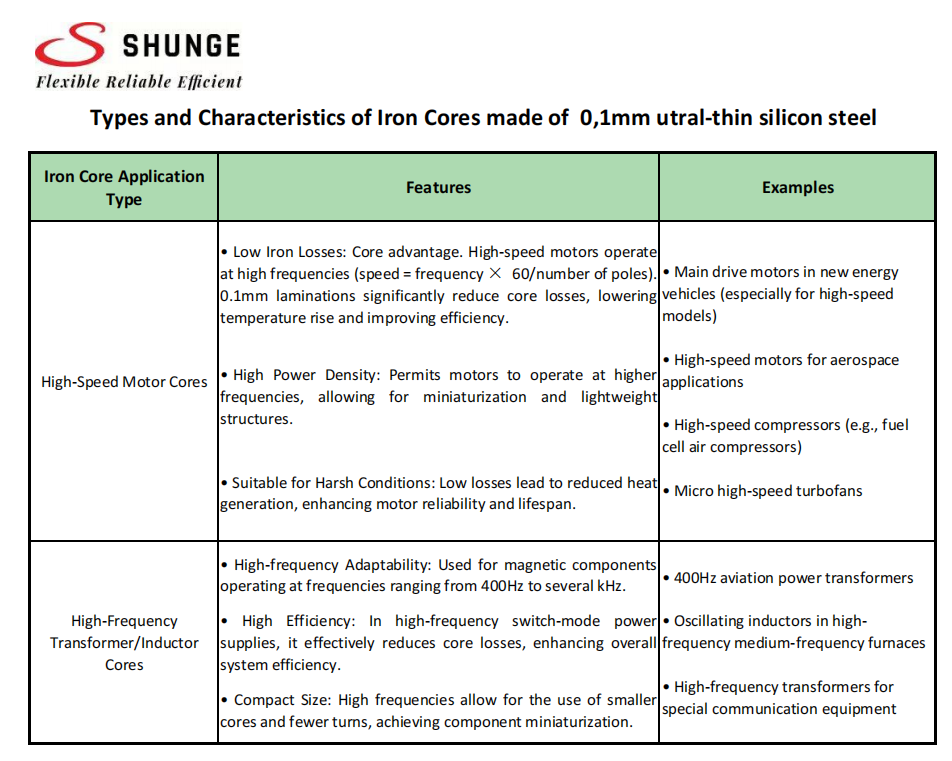
3. Comparison with Other Materials
vs. Common Non-oriented Silicon Steel (0.35/0.50mm): At the same frequency, the iron loss of 0.1mm sheets is significantly lower than the latter, making it the natural choice for stepping into high-frequency and high-speed applications.
vs. Ferrite: The saturation flux density is much higher than that of ferrite, allowing it to handle larger power and avoid magnetic saturation under high-frequency currents. However, ferrite still holds advantages in higher frequencies (MHz level) and costs.
vs. Amorphous and Nanocrystalline: Better processability, usually higher saturation magnetization, especially with stable performance at high temperatures. While amorphous and nanocrystalline materials may have lower losses at specific high frequencies, they are more brittle, with different cost structures.


Dirección : Room 201, West Building A, Dawei Logistics, Xihai Industrial Zone, Lecong Town, Shunde District, Foshan City
Puedes darte de baja en cualquier momento. Para ello, consulte nuestra información de contacto en el aviso legal.


 IPv6 RED SOPORTADA
We will contact you as soon as possible
Hi! Click one of our members below to chat on
 en
en fr
fr es
es